
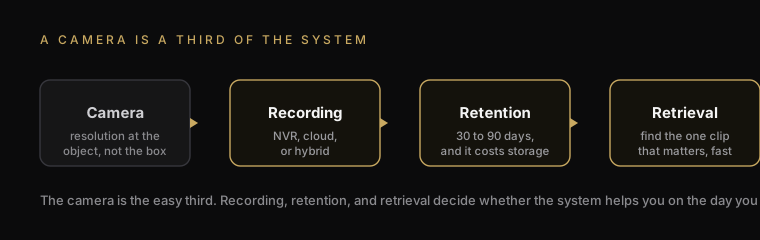
Walk into any trade show and you'll see the same pitch: sharper cameras, smarter AI, lower prices. All true, all beside the point. A camera is maybe a third of a surveillance system. The other two-thirds (recording, retention, and retrieval) are what determine whether the system helps you on the day you actually need it.
Start with the incident, not the hardware
Before speccing anything, answer one question: when something happens, what do you need to be able to prove?
- Identify a face or a plate: you need resolution at the distance in question, not on the box. A "4K" camera watching a parking lot entrance from 80 feet may deliver fewer useful pixels on a license plate than a modest camera mounted correctly at 20.
- Show what happened: wide coverage matters more than pixel count. Fewer, better-placed cameras beat a wall of redundant views.
- Satisfy an insurer or regulator: retention time is the spec that matters. Thirty days is a common requirement; some industries need 90 or more. Retention is a storage cost, and it's the number vendors most often quietly shrink to hit a price.
Where the footage lives (this is the real decision)
On-site recorder (NVR). You own the footage, no monthly fees, works if the internet is down. You're also responsible for the box, and if a burglar takes the recorder, they take the evidence. Recorders belong locked in a network room, not on a shelf by the back door.
Cloud-connected cameras. Footage offsite immediately, accessible from anywhere, updated automatically, for a per-camera subscription, forever. Multiply the monthly fee by camera count and by five years before deciding it's the cheap option.
Hybrid setups record locally and push critical events to the cloud. For most small and mid-size businesses, this is the sweet spot, but it demands a properly designed network to carry it.
The parts everyone skips
Cabling is the system's foundation. Modern cameras are network devices powered over the same cable that carries their video (PoE). That means every camera is only as reliable as the cable run and the switch behind it. A flaky camera is, in our experience, a flaky termination far more often than a flaky camera.
Lighting beats megapixels. A mediocre camera in a well-lit area outperforms a flagship staring into darkness. Sometimes the best surveillance upgrade is a $200 light fixture.
Somebody has to own it. Firmware updates, failed-camera alerts, storage health. Unmanaged systems degrade silently. The worst time to discover a camera died in March is during an incident in July. Decide up front whose job it is to notice.
Questions to ask any vendor
- What resolution do I get at the object I care about, not at the lens?
- How many days of retention at full quality, and what's the storage math behind that claim?
- What happens when the internet goes down?
- Who gets alerted when a camera or drive fails?
- What does adding four more cameras cost me in licenses, storage, and switch ports?
A vendor with crisp answers to all five is selling you a system. A vendor with brochures is selling you cameras.
Loading comments…