
People assume running more than one company means working more than one company's worth of hours. If that were true, it would not be possible, because there are only so many hours and I am not special.
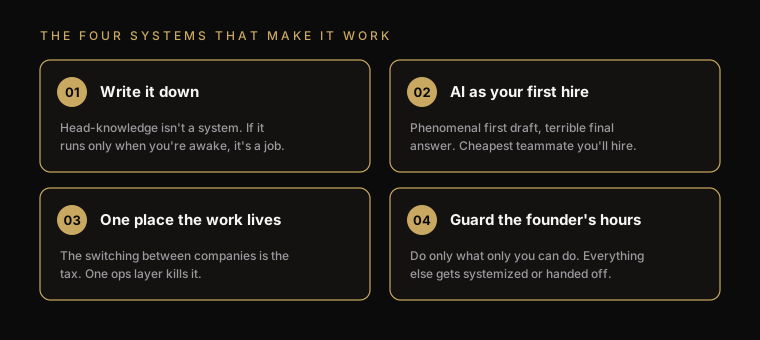
What actually makes it work is leverage. You build systems that run when you are not in the room, you use tools that do the work of people, and you get ruthless about spending your own hours only on the things that genuinely require you. Here are the four systems, and then I will take them one at a time.
You are not as alone as it feels
First, some perspective, because the "solo founder" thing can feel like you are doing something unnatural. You are not. The most common kind of business in America has zero employees. The Census Bureau counts about 30.4 million of these nonemployer businesses, and together they pull in roughly $1.8 trillion a year; that count climbed from 24 million to 30 million in under a decade (U.S. Census Bureau, 2025).
Lean is not the exception anymore. It is the default. The tools finally caught up to the ambition, and one person can now operate at a scale that used to require a department.
System 1: if it lives only in your head, it is not a system
The first thing that has to change is the stuff you carry in your head. Every recurring decision, every process, every "here is how we do this" has to get written down somewhere a person or a machine can follow it without you.
This feels like overhead when you are busy. It is the opposite. The half hour you spend documenting how a quote gets built, or how a customer gets onboarded, is the half hour that lets that thing happen without you next time. A company that only runs when the founder is awake is not a company. It is a job with your name on the lease.
System 2: AI is the first employee you can actually afford
This is the piece that genuinely changed the math in the last two years, and I do not say that as hype.
The adoption numbers are not subtle. McKinsey's latest research puts 79% of organizations at using generative AI, up from 33% just two years earlier, and nearly a quarter are already scaling AI agents that handle multi-step work on their own (McKinsey & Company, 2025). I lean on this hard: drafting, research, first passes at code, customer replies, turning a rough idea into a working document.
Be honest about the limit, though. AI is a phenomenal first draft and a terrible final answer. It does not replace judgment, and anyone who tells you it does is selling something. You still have to check it, own it, and put your name on it. Used that way, it is the cheapest, fastest teammate you will ever hire.
System 3: one place where the work lives
When you run several companies, the thing that kills you is not the work. It is the switching. Every time you jump from one company to another, you pay a tax reloading where everything stands.
The fix is boring and it works: one operating layer where the day-to-day actually lives. One place for the notifications, the tasks, and the status of everything in motion, across every company. We run ours through a single ops layer, so "what is happening right now" is a place I can look, not a thing I have to reconstruct in my head five times a day.
System 4: guard the hours only you can spend
There is a short list of things that genuinely require the founder. Setting direction. Closing the deals only you can close. The final call on anything that carries real risk. Keeping the culture and the quality bar where you set them.
Everything not on that list is a candidate to be systematized, delegated, or handed to AI. The discipline is not doing more. It is refusing to do the things that do not require you, even when you could, even when you are good at them. Every hour you spend on work something else could have done is an hour stolen from the work nobody else can.
What it actually costs you
I will not pretend this is free of downsides. Running lean across multiple companies means you are the single point of failure until your systems are strong enough to prove otherwise, and getting there takes real discipline. Context switching is a genuine cost even when you manage it well. And "the founder can technically do everything" quietly becomes "the founder is the bottleneck for everything" if you are not careful.
The systems are what keep that from happening. Not willpower, not long hours. Systems.
The whole thing in one line
Running multiple companies is not about being everywhere. It is about building things that work when you are not there, and being honest about the short list of moments that still need you. Do that, and the number of companies stops being the thing that limits you.
References
McKinsey & Company. (2025). The state of AI in 2025: Agents, innovation, and transformation. https://www.mckinsey.com/capabilities/quantumblack/our-insights/the-state-of-ai
U.S. Census Bureau. (2025, July). Number of U.S. nonemployers grew faster than employer businesses nearly every year from 2012 to 2023. https://www.census.gov/library/stories/2025/07/nonemployer-business-growth.html
Loading comments…