
I'm Connor Glass, and I founded Glass House Technologies. My first degree was actually in software, and I figured that's what I'd spend my career doing. Instead I kind of landed in networking, pulling cable and standing up the Wi-Fi, networks, and camera systems that businesses actually run on, and it stuck. Over the last few years we grew into something broader, a technology company that builds its own software instead of renting everyone else's, which in a way is just me circling back to where I started. Our storefront is part of that, and this is the honest story of why it runs on Medusa now. It took a couple of bad experiences to get there.
It started with the domain
We bought into Google Domains because it was Google, it was simple, and it was supposed to be one less thing to think about. Then Google sold the entire business to Squarespace, and just like that our domain belonged to a company we never chose (Squarespace, 2023). I'll be honest, it pissed me off. I had done everything right, picked the reliable option, kept it simple, and I still woke up one day as somebody else's customer with no say in it. That was the first real crack in the whole "just rent it and don't think about it" idea. When you rent the foundation, someone else can sell it out from under you.
Wix was fine, until it wasn't
Our storefront lived on Wix, and I want to be fair: Wix is fine. For a simple site it is genuinely good, and I would still point plenty of people to it. But the moment you want to build past the pre-packaged, canned functionality it hands you, you hit a wall. Every real customization turns into a workaround, a hack, or a flat "you can't do that here." We don't build canned-soup businesses. We build custom systems for other people for a living. Running our own store on a platform we couldn't actually build on started to feel ridiculous, like a mechanic taking his own car to the quick-lube because he isn't allowed to open his own hood.
What Medusa actually is
Medusa is an open-source commerce engine, and it exists because developers kept running into exactly that wall. The hosted platforms own your store and quietly decide how far you're allowed to build. Medusa flips it around. It is the commerce brain, the products, carts, orders, payments, and customers, and you run it yourself and build whatever front end you want on top.
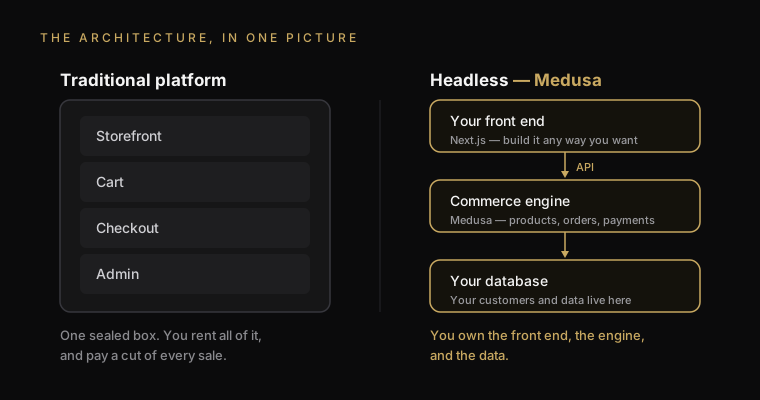
In plain terms, a traditional platform welds the storefront, the cart, the checkout, and the admin into one sealed box. Medusa is "headless," which just means the engine is separate from the face your customers see. You get the hard, must-not-break commerce logic as a foundation, and total freedom over everything else. It is a real project, not a science experiment: it raised an $8 million seed round led by LocalGlobe and Dawn Capital (Rindom, 2022), it is one of the most-starred commerce projects on GitHub (Medusa, n.d.-b), and it bills itself plainly as the open-source Shopify alternative (Medusa, n.d.-a).
The alternatives, and why Medusa won for us
We looked at the honest set of options.
Stay on the canned platforms. Cheapest to start, but we had already felt the ceiling and the loss of control.
Go to Shopify. And look, Shopify is excellent. If you are not technical, it is probably the right answer, full stop. But you rent it, and you pay a percentage of every sale for the privilege, forever.
| Plan | Monthly | Online card rate | Extra fee if you skip their processor |
|---|---|---|---|
| Basic | $39 | 2.9% + 30¢ | +2.0% |
| Grow | $105 | 2.7% + 30¢ | +1.0% |
| Advanced | $399 | 2.5% + 30¢ | +0.6% |
On real volume that is not a rounding error, and you still hit customization limits eventually.
Go headless. Once we decided to own our stack, there were a few headless engines to choose from. Medusa won for us specifically, and the reasons are specific:
- It is open-source and self-hostable, so we own the code and the data outright.
- It is TypeScript and Node, which is our stack, not a language we would have to go learn.
- The storefront is Next.js, exactly what we already build in.
- There is no per-feature paywall, so when we wanted our own product manager, admin console, and analytics, we just built them.
- We already build software, with AI agents doing a lot of the heavy lifting under our direction, so owning this much surface area is an advantage for us instead of a burden.
That last point is the whole thing. For a business that can't code, none of this applies, and Shopify is the right call. For us, renting our own storefront made no sense.
The honest review
We're called Glass House for a reason. We like to own what we run, label it, and understand every part of it. Renting our storefront, on a domain that got sold out from under us, on a platform we couldn't build on, violated all of that. Medusa let us own the foundation and build exactly what we want on top of it.
So here is my honest review. If you can build software, headless commerce with Medusa is a genuinely different way to run a store, and I would do it again tomorrow. If you can't, stay on the hosted platforms and don't feel bad about it for a second. The only real mistake is renting something you were fully capable of owning. Knowing which one you are is the whole decision.
References
Medusa. (n.d.-a). Medusa: The open-source Shopify alternative. https://medusajs.com/
Medusa. (n.d.-b). medusajs/medusa [Source code repository]. GitHub. https://github.com/medusajs/medusa
Rindom, S. (2022, July 15). Announcement: Medusa's $8M USD seed round to build the leading e-commerce platform for developers. Medusa. https://medusajs.com/blog/announcement-8m-usd-seed-round-to-build-the-leading-ecom-platform-for-devs/
Shopify. (n.d.). Pricing. https://www.shopify.com/pricing
Squarespace. (2023, September 7). Squarespace completes acquisition of Google Domains assets. https://www.squarespace.com/press-releases/2023/9/7/squarespace-completes-acquisition-of-google-domains-assets
Loading comments…