
The first location grew organically: a router from the office-supply store, a camera system from a big-box shelf, passwords in somebody's head. It works, mostly, because you're there to kick it when it wobbles.
Location two is different. You can't be in two places, so the technology has to behave without you. The decisions you make now decide whether opening location five is a checklist or a crisis.
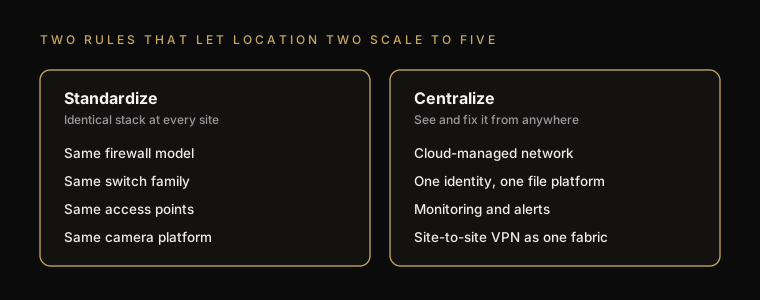
Standardize before you multiply
Whatever you deploy at the new site becomes your de facto standard, so choose deliberately, once. Same firewall model, same switch family, same access points, same camera platform at every site. Identical hardware means identical fixes: a problem solved at one location is solved at all of them, and spares work everywhere.
Write down the standard: make, model, configuration, and who to call. If it lives in someone's head, you don't have a standard. You have a dependency.
Centralize what you can't drive to
Management. Cloud-managed networking (firewall, switches, Wi-Fi) lets you (or your IT partner) see and fix both sites from anywhere. When the store manager says "internet's down," someone should be looking at the switch port in ninety seconds, not driving forty minutes to look at blinking lights.
Identity and files. Shared logins and a PC full of spreadsheets don't survive multiplication. One identity platform, one file platform, permissions by role. Set up at two sites, it scales to twenty.
Monitoring. You want to know the second location's internet failed at 6:04 AM from an alert, not from a 9:15 AM phone call about the credit card machine.
Connect the sites like you mean it
A proper site-to-site VPN (or SD-WAN as you grow) makes location two an extension of your network instead of an island. Point-of-sale reporting, cameras, file access, and phones all get simpler when the network is one fabric. Order the new site's internet circuit the day the lease is signed. It's the longest lead-time item in the entire project.
Cable it once, correctly
You control the walls exactly once, during build-out. Structured cabling to every register, office, camera, access point, and TV (certified, labeled, documented) costs a fraction during construction of what it costs after. Pull spares. Growth at a successful location is not a hypothesis.
The mistake that caps growth
The pattern that stalls multi-site companies isn't bad technology. It's bespoke technology. Every site slightly different, every fix an adventure, every opening reinventing the last one. The playbook is boring on purpose: standard hardware, central management, documented everything. Boring is what scales.
Loading comments…