
Ask five contractors what a cable drop costs and you'll get five versions of "it depends." That's true, and also unhelpful when you're trying to budget a build-out. So here are real ranges, and more importantly, what moves a project inside them.
The honest per-drop range
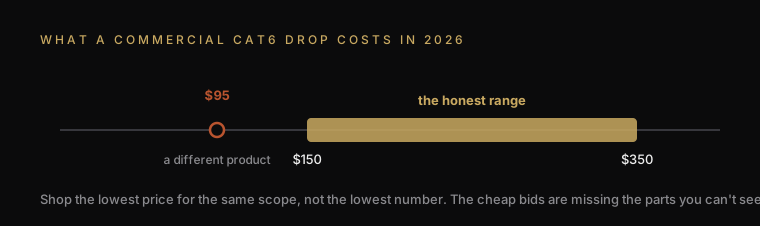
For a typical commercial Cat6 drop (pulled, terminated both ends, tested, labeled) most U.S. markets land between $150 and $350 per drop in 2026. Where you fall in that range comes down to:
Building conditions. Open ceiling grid with existing pathway is the cheap end. Hard-lid ceilings, plaster walls, long horizontal runs, or after-hours access requirements push you up fast. A drop in a warehouse and a drop in a 1920s bank building are different jobs wearing the same name.
Quantity. Mobilization is a fixed cost. Forty drops in one visit costs far less per drop than four visits of ten. If you know more construction is coming, pulling extra runs while the ceiling is open is the cheapest cable you will ever buy.
Jacket rating and category. Plenum-rated jacket (required in air-handling ceilings) adds real material cost. Cat6A for high-bandwidth or PoE-heavy loads costs more than Cat6, and is worth it for wireless access points and cameras you'll still be running in eight years.
Certification. Testing every run against the TIA standard with a calibrated certifier, and handing you the reports, is a line item. Skipping it is how low bids get low.
Where cheap installs hide their costs
A $95-per-drop quote is not a miracle; it's a different product. The usual missing pieces: riser cable in plenum spaces (fails inspection), no test reports (you find the bad runs later, one outage at a time), cable resting on ceiling tiles instead of supports (code violation), no labeling (every future change bills you for tracing), and subcontracted labor with no accountability when terminations start failing.
The most expensive cabling in any building is the cabling that has to be done twice.
Budget rules of thumb
- New office build-out: 2 drops per workstation, 1 per printer/copier area, 2 per conference room, 1 per access point and camera. Add 20% spare. You will use it.
- Retrofit: get unit pricing for additions in writing before signing. Adds priced mid-project cost 2 to 3× adds priced in the bid.
- Multi-site rollouts: national pricing per drop, one accountable vendor, and identical documentation at every site beats fifty local relationships every time.
The one-line takeaway
Don't shop for the lowest price per drop. Shop for the lowest price per drop for the same scope (jacket rating, certification, labeling, documentation, warranty) and make every bidder price that scope. The spread narrows fast, and what remains is the real market.
Loading comments…