
A project name and a status label only tell me so much. As the work gets more complicated, I want to see the smaller pieces, understand what is happening inside them, and know what still needs attention.
That is the idea behind Lattice. The screenshot here comes from the actual local development workspace. You can see a project broken into individual tasks, with its recorded progress and the project details beside it. The useful change is that the project starts to become something we can inspect rather than just a name in a list.
For a project with several moving parts, that structure gives us a better way to discuss the work. We can look at a particular task, connect it to the larger objective, and identify which part needs another decision or another round of implementation. The view should help us understand the relationship between the pieces as the project develops.
The screenshot also shows why I want to keep progress and readiness clear. A recorded task count is information about the work in the system. It is not proof that an application is ready for production. Lattice is currently a local development implementation, and its production integration with OnlyTechs is still pending.
I want to build toward a project structure that stays useful as the work changes. Breaking the project into parts is the beginning. The larger goal is to keep the overall picture connected to what is actually happening on those tasks, so we can spend more attention on the work and less on reconstructing its status.
This is especially relevant as we develop more of the GHT applications together. Communication, documents, and operational tools all create work that needs a clear place. Lattice is a look at how I want to organize that growing effort and make it easier for other people to see what we are building.
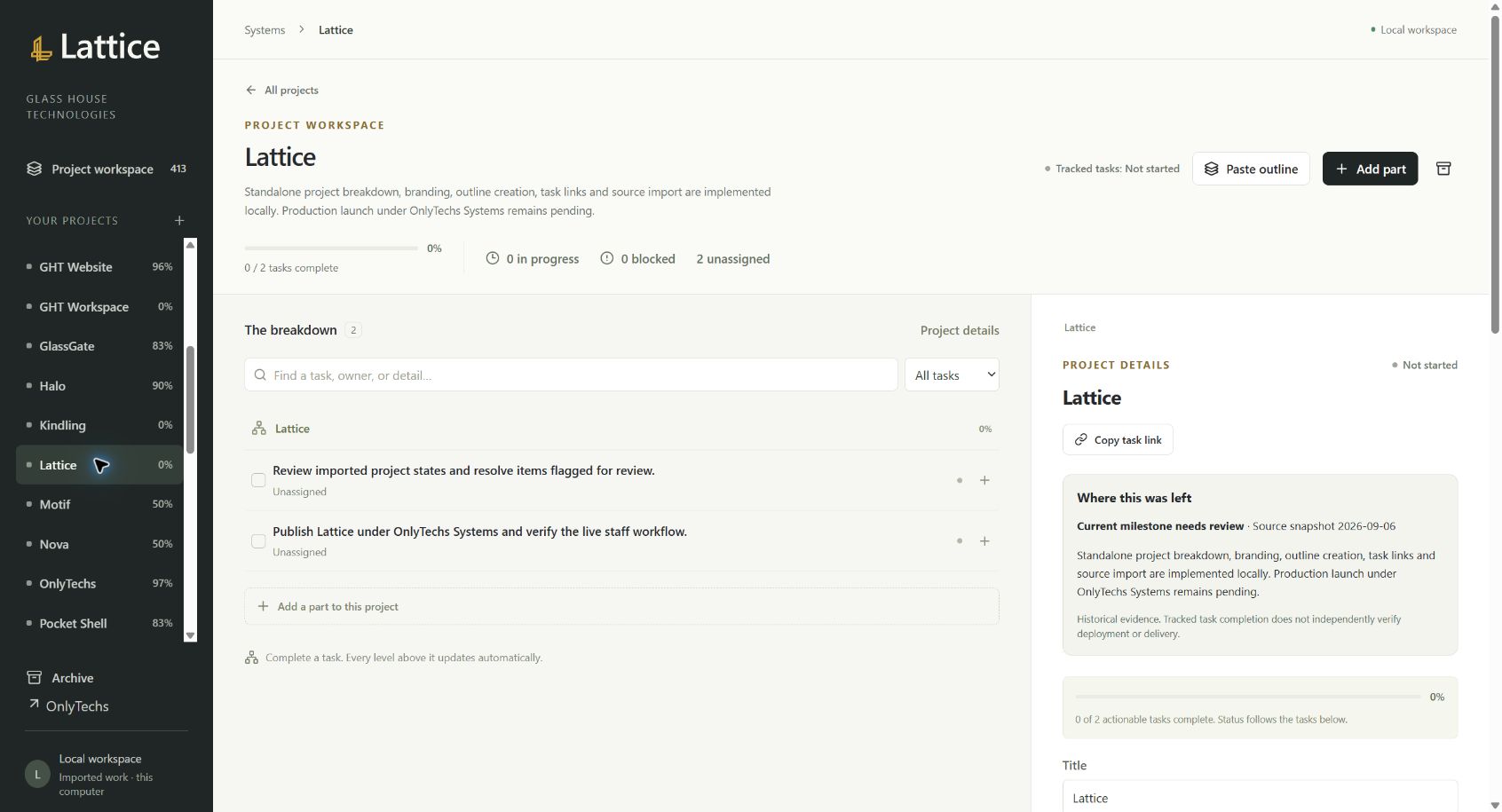
Actual local development workspace, captured September 6, 2026. Recorded tasks are not a production-readiness score. Production integration remains pending.
Loading comments…